
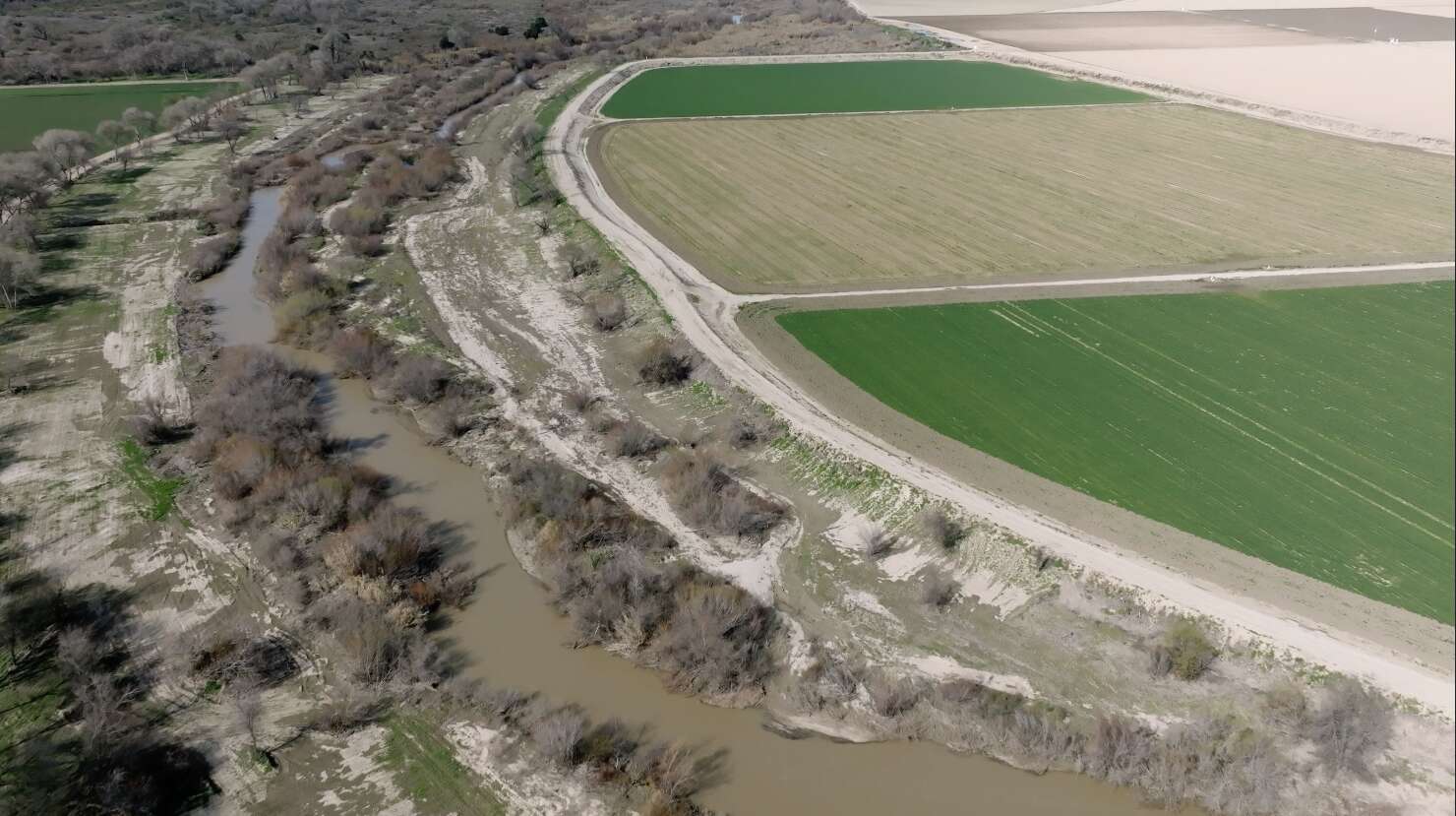
The Salinas River conveys surface water through the Salinas Valley providing an important riparian corridor and source of groundwater recharge. In March 2026, in collaboration with Monterey County Water Resources Agency (MCWRA), SVBGSA completed the Castroville & Eastside Canals and Alternatives Feasibility Study (C&E Study) to evaluate surface water diversion opportunities from the Salinas River that could support Sustainable Groundwater Management Act (SGMA) implementation.
The C&E Study builds upon longstanding concepts — dating back to the 1940s — for diverting excess flows from the Salinas River through the Castroville and Eastside Canal systems to address seawater intrusion and raise groundwater levels in the 180/400-Foot, Eastside and Langley subbasins. The feasibility study team includes Montgomery & Associates (M&A), MBK Engineers, Wallace Group, and Denise Duffy & Associates. The C&E Study includes an evaluation of water rights options, a review of historical documents, an analysis of surface water availability and the identification of viable project components for potential diversion and conveyance systems. Results will inform SVBGSA’s long-term project portfolio for achieving SGMA sustainability targets.
The C&E Feasibility Study includes several appendices with detailed information about the following topics:
Appendix A and Appendix B: Water Rights History and Evaluation of Water Right Options (MBK Engineers)
The C&E Study focuses on evaluating whether existing surface water rights, including Permit 11043 held by MCWRA, can be utilized or modified to develop diversion projects that contribute to groundwater sustainability goals. The C&E Study also looks at new water rights and flood flows as potential sources of surface water.
Appendix C: Historical Document Review (Montgomery & Associates and Wallace Group)
120 proposed projects from past studies were reviewed, of which about 30 were relevant diversion concepts.
Appendix D: Salinas River Historical Flow Analysis (Montgomery & Associates)
Excess historical Salinas River flows are calculated based on subtracting reservoir releases from flow at the USGS Salinas River at Soledad gage, for days when the three-day running average exceeded the minimum required instream flows noted in the Permit.
Appendix E: Salinas River Project Flow Analysis (Montgomery & Associates)
Future Salinas River flows are estimated using the Salinas Valley Operational Model and analyzing the relative differences in diversion availability.
Appendix F: Infrastructure Components Analysis (Wallace Group)
Key technical considerations of the potential project components were identified including diversion methods, diversion locations, conveyance, end uses and storage.
Appendix G: Surface Storage Analysis (Wallace Group)
Starting with proposed locations identified in previous studies, off-stream reservoir sites for surface water storage were investigated.
Appendix H: Hydrogeologic Context for Recharge Basins and Injection Wells in the Eastside Subbasin (Montgomery & Associates)
Alluvial fans in the Eastside Subbasin require hydrogeologic assessment for where groundwater recharge could be effective using different methods.
Appendix I: Modeling Results (Montgomery & Associates)
Modeling was conducted to inform comparative, planning-level assessment of how project concepts could help reach groundwater sustainability goals.
Appendix J: Estimates (Wallace Group)
Cost for 8 scenarios were estimated for concept screening purposes and preliminary budget considerations.
Appendix K: Permitting Analysis (Denise Duffy & Associates)
High-level evaluation of the regulatory approvals and potential permits that may be required for project concepts considered in the C&E Study.