The Salinas Valley relies heavily on groundwater to support farms, communities, the environment, and the regional economy. Under the Sustainable Groundwater Management Act (SGMA), the Salinas Valley Basin Groundwater Sustainability Agency (SVBGSA) is responsible for managing six groundwater subbasins to avoid significant and unreasonable impacts such as seawater intrusion, declining water levels, degraded water quality, and loss of groundwater storage.
Demand management is one of the tools available to help achieve long-term groundwater sustainability. It means actively managing net pumping (groundwater extraction minus recoverable return flows) to maintain basin balance and avoid undesirable results. Demand management can be applied alongside projects that augment groundwater supplies and recharge to ensure the valley remains resilient under changing hydrologic conditions.
Background
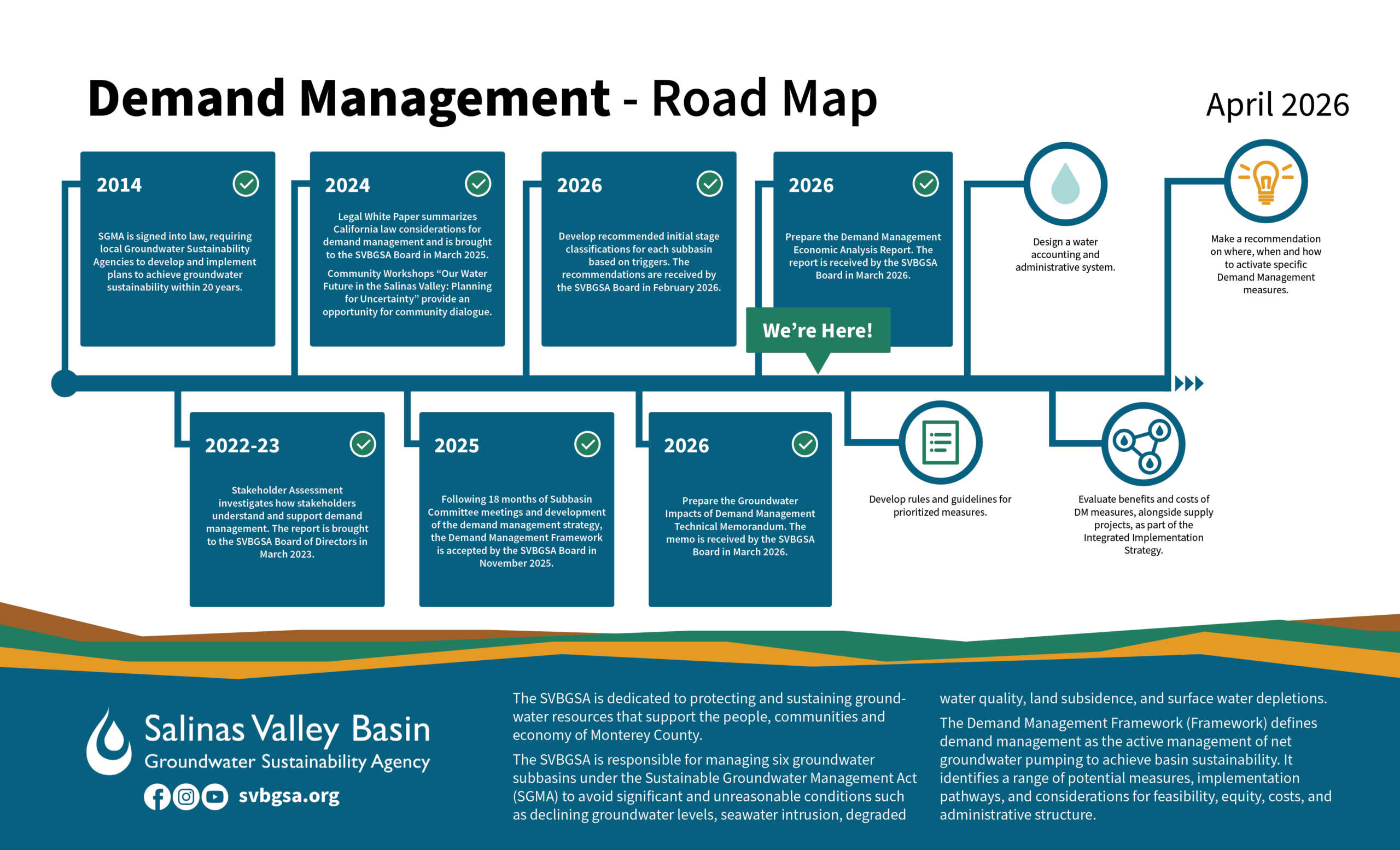
When SGMA was passed in 2014, it required local Groundwater Sustainability Agencies to develop and implement plans to achieve groundwater sustainability within 20 years. The SVBGSA manages six subbasins: the 180/400-Foot Aquifer, Eastside, Forebay, Upper Valley, Monterey, and Langley Area.
All six subbasins now have Department of Water Resources–approved Groundwater Sustainability Plans (GSPs). Each GSP identifies groundwater conditions, establishes sustainability criteria, presents water budgets, and outlines projects and management actions to achieve long-term balance. The GSPs recognize that both supply augmentation and demand management will be needed.
Since 2022, SVBGSA has advanced demand management planning through several activities:
- Stakeholder Assessment (2022–2023): Assessed how stakeholders understand and support demand management.
- Legal White Paper (2024): Summarized California law considerations for demand management. The white paper was prepared by Minasian in coordination with staff and legal counsel from Arroyo Seco GSA, Marina Coast Water District GSA, Monterey County Water Resources Agency, and Monterey County Environmental Health; and received by SVBGSA Board on March 13, 2025.
- Community Workshops (2024): “Our Water Future in the Salinas Valley: Planning for Uncertainty.”
- Economic and Financial Analyses (2024–2025): Evaluated costs and feasibility of different approaches.
This work culminated in the Demand Management Framework, accepted by the SVBGSA Board in November 2025. Since then, SVBGSA has advanced technical work to support implementation, including development of methods for stages and triggers, prioritization of demand management measures, and preparation of technical memoranda evaluating groundwater and economic impacts of demand management.
The Demand Management Framework
The Framework is a planning tool. It does not activate measures, but it provides a structure for how the SVBGSA can evaluate, prioritize, and implement measures if and when they are needed to meet SGMA requirements.

Key Components
- Stages & Triggers: Five stages (0–4) classify groundwater conditions, from sustainable (Stage 0) to probation risk (Stage 4). Triggers include both long-term conditions (evaluated every five years) and short-term indicators (such as annual groundwater level declines or reduced reservoir releases).
- Global Elements: Administrative requirements, funding approaches, technical and economic analysis, measurement methods, and a water accounting system.
- Agricultural Measures (6): On-farm efficiency, demand management fee, rotational fallowing/fallow bank, land repurposing, pumping limits, penalties for excess use.
- Domestic Measures (4): Education and outreach, incentivized efficiency (rebates), mandatory efficiency requirements, and water pricing mechanisms.
- Costs and Feasibility: The Framework includes a preliminary assessment of costs to the agency, water users, and the regional economy. Additional technical memoranda completed in 2026 provide more detailed analysis of groundwater and economic impacts.
The Framework establishes the foundation for future SVBGSA actions.
Recent Technical Work (2026)
Since adoption of the Framework, SVBGSA has completed additional technical analyses to better understand how demand management may affect groundwater conditions and the regional economy:
- Methods and Initial Recommendations for Demand Management Stages and Triggers
- Groundwater Impacts Technical Memorandum: Evaluates how demand management measures influence net groundwater conditions, including the role of return flows and differences across subbasins. Findings show that reductions in pumping do not uniformly translate into groundwater benefits and must be evaluated within the full groundwater budget.
- Economic Analysis Report: Assesses potential economic effects of demand management, including impacts to agricultural production, employment, and regional economic activity. Results indicate that impacts may increase with the magnitude of pumping reductions and will depend on how measures are designed and implemented.
These analyses provide a stronger technical foundation for evaluating demand management measures and informing future policy and program development.
Next Steps:
- Further developing and evaluating prioritized demand management measures
- Developing program rules, guidelines and administrative approaches
- Designing a water accounting and implementation approach
- Integrating demand management with supply augmentation projects through the Integrated Implementation Strategy.
Documents and Resources
Groundwater Impacts of Demand Management – Technical Memorandum (March 2026)
Evaluates how demand management could influence groundwater conditions across the Salinas Valley, including the role of return flows and variations among subbasins. Findings highlight that reductions in pumping do not always translate directly into groundwater benefits and must be assessed within the full groundwater budget.
Economic Analysis Report (March 2026)
Assesses the potential economic effects of demand management on agricultural production, employment, and the regional economy. Results show that economic impacts increase with the magnitude of pumping reductions and depend on how measures are designed and implemented.
Methods and Initial Recommendations for Demand Management States and Triggers (February 2026)
Presents the methodology and initial recommendations for defining demand management stages and triggers based on groundwater conditions. Establishes a structured, data-driven approach to determine when and how demand management actions may be considered.
Demand Management Framework (November 2025)
Establishes the overall structure for evaluating, prioritizing, and implementing demand management measures in the Salinas Valley. The Framework serves as a planning tool — defining stages, triggers, and potential actions — while not activating specific measures.